Premier Cup soccer is rarely dangerous for sportsbook operators because of the final score alone. The real risk usually appears in the sequence of events that gets the match there: a penalty after a long review, a red card that changes team shape, a late equalizer that shifts live totals, or a momentum swing that turns a comfortable position into an unstable market.
That is why the 2-2 draw between Bournemouth and Manchester United at the Vitality Stadium on March 20, 2026, offers a useful case study for live betting models. United led twice, Bournemouth responded twice, and Harry Maguire’s late red card helped create the conditions for Junior Kroupi’s penalty equalizer. For a casual viewer, it was simply a dramatic Premier League match. For a sportsbook trading team, it was a reminder that draw outcomes in high-pressure soccer matches can expose weaknesses in live pricing, liability control, and event-weighted risk models.
The challenge is not just predicting whether a match ends level. It is understanding how quickly the probability of a draw can expand when match conditions become unstable.
Why Draws Create A Different Kind Of Live Betting Risk
In live soccer markets, the draw is often treated as a passive outcome. It becomes more likely as time passes without scoring, then drops sharply when one team takes the lead. That basic structure works in stable match states, but Premier Cup soccer rarely stays stable for long.
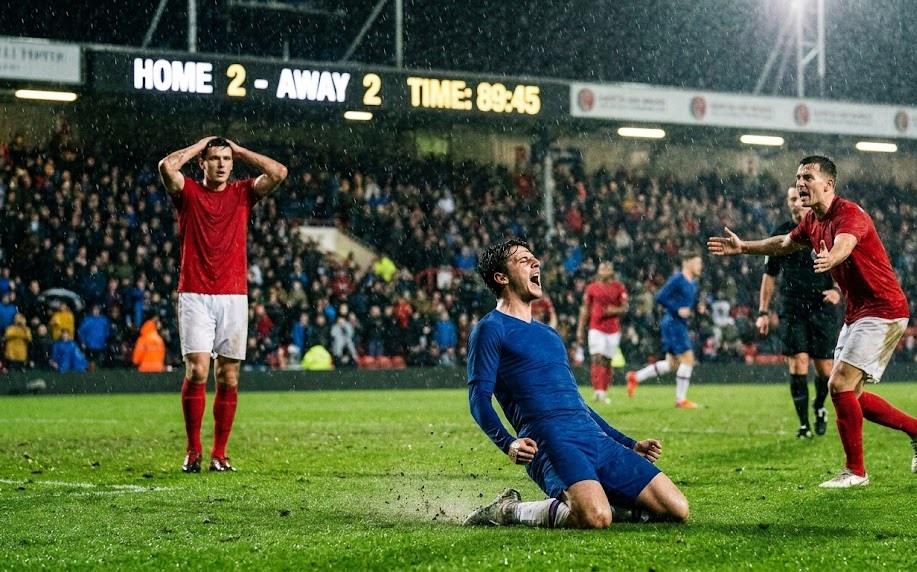
A draw can suddenly become a high-liability position when multiple factors converge. A favorite leading by one goal may attract heavy live money. An underdog equalizer can trigger instant exposure on the draw. A red card can make the trailing team more aggressive or force the leading team into a defensive block. If the model reacts too slowly, the sportsbook may carry stale odds during the most expensive seconds of the match.
The United-Bournemouth match showed exactly why this matters. Bruno Fernandes put Manchester United ahead from the penalty spot, Bournemouth equalized through Ryan Christie, United moved back in front through a James Hill own goal, and the match swung again after Maguire’s dismissal led to Kroupi’s penalty. Each event did not just alter the score. It changed the structure of the live market.
That is where live betting models need more than clock, score, and possession. They need context.
The Problem With Score-Based Live Models
A basic live betting model may treat a 1-1 match in the 70th minute similarly across different games. But the risk profile changes dramatically depending on how the match reached that point.
Was the favorite dominant but unlucky? Did the underdog’s equalizer come from sustained pressure or one counterattack? Has the referee shown a low tolerance for contact? Is one center back on a yellow card? Is the favorite’s defensive line tiring? These factors may not always show up cleanly in a score-based pricing model, but they strongly influence live draw probability.
This is where sportsbook software has to move beyond static assumptions. A match can be 2-1 and still be unstable if the leading team is down to ten players, conceding territory, and defending repeated penalty-area entries. A match can be 1-1 and still carry low draw risk if both sides are structurally cautious and chance creation has collapsed.
Operators using sportsbook risk heatmaps can visualize these pressure points more effectively by connecting market exposure with match events, time segments, and liability concentration. The goal is not simply to know where money is sitting. The goal is to know when that money is sitting on a market that is becoming structurally fragile.
How Match Events Distort Live Pricing
Live betting models often depend on fast data feeds, probability engines, and automated trading rules. But the most dangerous Premier Cup soccer matches are usually those where events create layered uncertainty.
In the Bournemouth-Manchester United draw, several event types mattered at once: penalties, equalizers, an own goal, a red card, and late-game defensive pressure. The requested match analysis of Manchester United’s draw with Bournemouth framed the result as a season run-in warning for United, but from an operator perspective, it also reads like a risk-management warning for live trading desks.
| Match Event | Live Betting Risk Created | Model Adjustment Needed |
|---|---|---|
| Favorite takes narrow lead | Heavy money may move toward favorite protection markets | Reprice draw and underdog comeback probability faster |
| Underdog equalizes | Draw liability can spike immediately | Reduce stale draw exposure and monitor cash-out pressure |
| Own goal restores lead | Market may overreact to scoreboard rather than flow | Separate score impact from performance indicators |
| Red card to leading team | Late equalizer probability rises sharply | Adjust team strength, territory expectation, and totals |
| Penalty equalizer | High-volatility settlement event | Tighten suspension rules around VAR and penalty decisions |
The most important lesson is that live models should not treat all goals equally. A penalty after a red card carries a different informational value than an open-play goal from sustained pressure. An own goal may change the score without proving the scoring team has control. A late equalizer can be both a result event and a signal that the favorite’s defensive structure has failed.
Why In-Play Draw Exposure Can Build Quietly
Sportsbook risk is often visible when one side attracts overwhelming pre-match action. Draw exposure is more subtle. It can accumulate through live bettors reacting to score pressure, cash-out patterns, same-game parlays, and late-game hedging behavior.
In Premier Cup soccer, the draw becomes especially sensitive when a major club is involved. Manchester United matches attract high liquidity, emotional betting, and fast reactions to momentum swings. When a team with a large public following takes a narrow lead, many bettors expect them to close the game. If the opponent continues creating chances, the sportsbook may be exposed in multiple directions at once: favorite win, both teams to score, over totals, and draw protection markets.
That overlap creates hidden correlation. A single late penalty can trigger losses across several connected markets. If the platform’s risk model treats each market too independently, the trading desk may underestimate total exposure.
This is why operator-grade sportsbook software must calculate draw risk as part of a broader liability network, not as an isolated 1X2 outcome.
The Role Of Red Cards In Live Betting Models
Red cards remain one of the hardest events for live models to price correctly because their impact depends on timing, scoreline, team quality, substitutions, and tactical behavior.
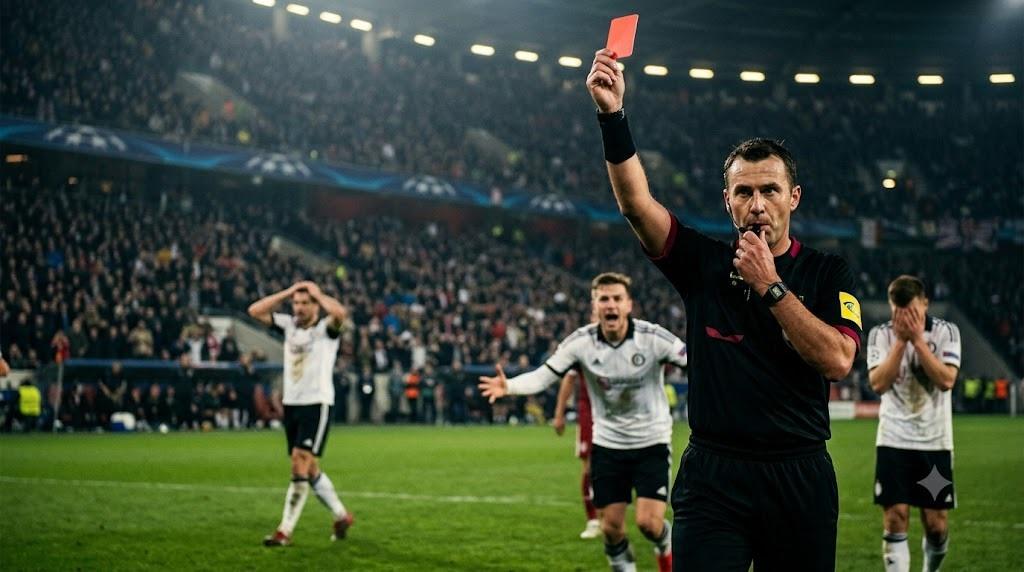
A red card to a trailing team can reduce attacking output and lower comeback probability. A red card to a leading team can do the opposite. The team ahead may defend deeper, invite pressure, concede corners, and increase the probability of late penalty-area incidents. That does not guarantee an equalizer, but it changes the distribution of possible outcomes.
In the Bournemouth-Manchester United case, Maguire’s red card did more than reduce United to ten men. It changed the tactical incentives. Bournemouth had more reason to attack, United had more reason to protect space, and the draw became a more dangerous live position.
For risk teams, the red card should trigger several immediate adjustments:
- Team strength recalibration based on which player was dismissed and the current scoreline
- Automatic review of draw, totals, next goal, and cash-out exposure
- Suspension or manual confirmation rules for penalty-related sequences
Those rules are especially important in matches involving high-volume clubs because even a short delay can create exploitable pricing gaps.
What Better Live Betting Models Should Measure
The best live betting models should not be built only around probability. They should be built around probability under pressure.
That means combining match data with trading data. Shots, expected goals, cards, substitutions, territory, and possession all matter, but so do stake distribution, customer behavior, bet velocity, and correlated liability. A model that sees the match but not the book is incomplete. A model that sees the book but not the match is just as vulnerable.
For Premier Cup soccer, stronger live models should measure:
- Score state and time remaining
- Card impact by player position
- Momentum before and after goals
- Penalty and VAR sensitivity
- Public-team betting concentration
- Cross-market liability correlation
- Cash-out demand after major incidents
This type of model does not eliminate risk. It makes risk more visible before it becomes expensive.
Premier Cup Soccer Shows Why Human Traders Still Matter
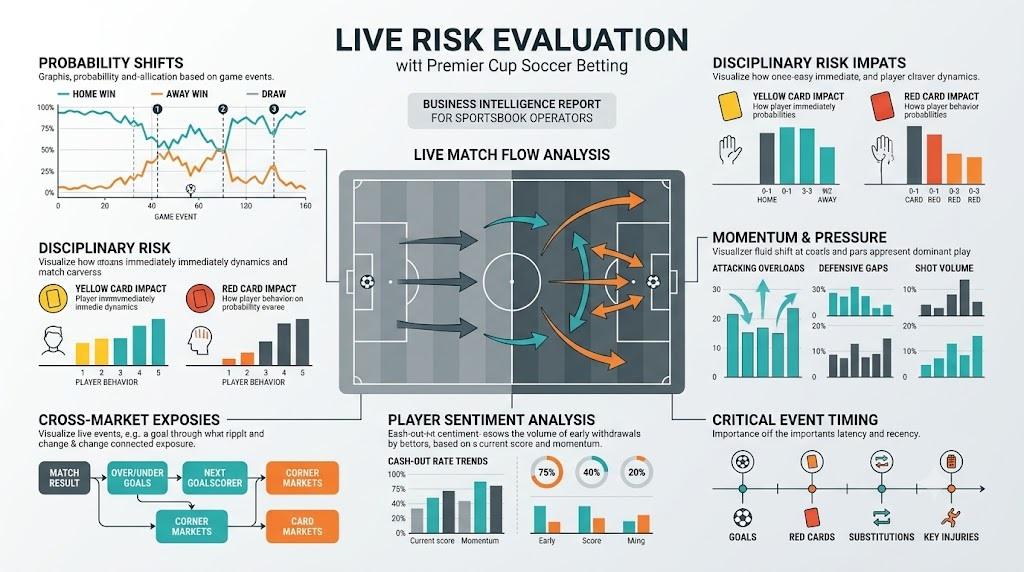
Automation is essential in modern sportsbook operations, but live soccer remains too dynamic for software to manage without oversight. Models can process data quickly, but human traders still provide context around referee behavior, crowd pressure, tactical substitutions, and whether a team looks capable of surviving pressure.
The most effective setup is not human versus machine. It is model-led trading with human escalation. Software should identify volatility, suspend markets when necessary, and highlight exposure clusters. Traders should interpret whether the model is missing something that the match itself is clearly showing.
The Bournemouth-Manchester United draw is a useful example because the risk did not arrive all at once. It developed through layers: United’s narrow leads, Bournemouth’s responses, officiating pressure, red-card disruption, and late-game psychology. A strong model should have recognized that the match was becoming less predictable long before the final whistle.
The Operational Lesson For Sportsbook Software Teams
Premier Cup soccer draws are not just betting results. They are stress tests for live betting infrastructure.
When a high-profile match ends 2-2 after penalties, a red card, and repeated momentum shifts, the sportsbook’s systems reveal whether they can price uncertainty in real time. The most dangerous risk gaps usually appear when the scoreboard says one thing, but the match state says another.
For operators, the lesson is direct: live betting models must be event-aware, correlation-aware, and exposure-aware. A draw is not always a neutral outcome. In the wrong match, at the wrong time, with the wrong liability profile, it can become the most expensive result on the board.
A smarter sportsbook platform should recognize that before the market does.