Imagine a volunteer fire department where every crew had their own hose connections. It would be chaotic, right? That’s what happens without clear procedures.
An Standard Operating Procedure isn’t just a bunch of rules. It’s your guidebook. Officially, it’s an organizational directive that sets a. It’s like your team’s muscle memory.
This playbook ensures everyone is on the same page. It reduces misunderstandings and makes job roles clear. This leads to better safety, performance, and team spirit.
Not using this tool can lead to big problems. It can cause costly mistakes and legal issues. A good set of procedures turns random actions into a reliable process. It’s your shield against market chaos.
Keep your playbooks up to date. It’s the best investment for your desk’s success.
Pre-Game, In-Play, and Post-Game Checklists
Think of your trading day as a three-act play. Each act needs its own plan. Project managers build skyscrapers in phases. They start with a plan, then design, build, and finish.
Your trading desk needs the same structure. Playbooks help turn chaos into a routine.

The Pre-Game phase is your plan. It’s like the first phase of building a skyscraper. This is where you check the foundation.
- Economic Calendar Recon: Look for big events. Is it a Fed speech day or a major data drop? Treat this like a site survey.
- Risk Limit Calibration: Set your limits. What’s your max drawdown? Your position size caps? Write them down.
- System Diagnostics: Check your trading platform, data feeds, and internet. No builder starts with faulty tools.
- Strategy Briefing: Review your plan for the session. What conditions trigger an entry? Where is the exit?
Once the bell rings, you’re in In-Play. This is like managing the live build. Market noise is your constant stream of RFIs—Requests for Information. Your playbooks here are about quick response, not rigid prediction.
- Live Position Dashboard: Watch key metrics like P&L, delta, and volatility in real-time. One screen for this. No digging.
- News & Alert Triage: Is that headline market-moving noise or a structural shift? Have a protocol to decide.
- Execution Log: Document every trade, with reason. This is your quality control log.
- Breach Protocol: If a risk limit is touched, what’s the immediate, unemotional action? This step must be autopilot.
The closing bell doesn’t mean your work is done. This is the Post-Game, your Phase 4 Post-Occupancy Evaluation. The project managers don’t just walk away; they assess what worked and what didn’t. Your profit and loss statement is just the headline. The real gold is in the forensic review.
- P&L Attribution: Was today’s win due to skill or luck? Which specific trade or decision drove the result?
- Process Audit: Did you follow the Pre-Game checklist? Which In-Play alerts were useful, and which were the boy who cried wolf?
- Journal Entry: Write one clear lesson. Was there a emotional leak? A missed signal? This isn’t a diary; it’s a data point.
- Tool & Tech Feedback: Did any platform lag? Was a charting tool ineffective? Note it for the tech team.
Without these structured playbooks, you’re just a spectator reacting to the market’s plot twists. With them, you become the author. The Pre-Game checklist ensures you enter the arena prepared. The In-Play playbooks keep you disciplined amidst the noise. The Post-Game debrief turns experience into genuine edge.
So, ask yourself: are you running a sleek operation or a improv comedy show? The difference lies in the lists you use before, during, and after the action. Build these playbooks. Refine them. Your consistency depends on it.
Role Rotations and Handover Notes
Imagine a relay race where a runner just drops the baton and walks away. That’s what happens when a trader leaves without a proper handover. A simple “Google’s long, Amazon’s short” as you leave is not enough. It’s a big deal on a trading desk, where risks and important information are at stake.
The day shift is like the Design Manager, planning and preparing. The night shift is the Construction Manager, executing the plan and handling surprises. If the Design Manager just emails and leaves, it’s chaos. Yet, this is common on trading floors.
A good handover includes both numbers and context. It’s not just about the numbers; it’s about understanding the situation. Your notes should explain why and what to do next.
Here’s what a good handover looks like:
- The “Why” Behind the Position: Was it a tactical move or a strategic choice? Knowing the intent is key.
- The Unfinished Symphony: What emails need a response? What’s the status with brokers? These are tasks for the next shift.
- The Market’s Subtext: What news is being overlooked? Is there something odd in the broker chat? This is where algorithms fall short.
- The Risk Radar: Are there any unusual positions that need attention? Full details are essential.
This approach makes handovers a critical part of risk management. But it only works if roles are rotated. Staying in one role for too long creates a knowledge gap. It’s like having one person who knows everything about a complex trade.
Role rotations break down these knowledge silos. They ensure that everyone understands the important details. It’s not just about scheduling; it’s about building a strong team.
Desk resilience is tested during the handover, not just during trading hours. A clear and detailed handover ensures a smooth transition. It’s what keeps the operation running smoothly, no matter who’s in charge.
Escalation Trees and SLAs
Your escalation protocol is like a fire drill, but with real money and fines at stake. It’s when your Standard Operating Procedure turns from a guide to a legal shield. When a trade fails or a compliance issue arises, “we’ll figure it out” is not a plan. It invites chaos.
An escalation tree is your emergency map. It shows the path a problem takes, from the desk to the Chief Risk Officer. Each step has a Service Level Agreement that sets a time limit for action. For example, a tech failure might need a five-minute response, while a compliance issue might need ten minutes.
This structure is important for legal reasons. Courts look at the system behind the mistake, not just the mistake itself. They check if there was a demonstrable framework for maintaining the SOP. They also look at if the system was compatible with regulations and if there were procedures for monitoring performance.
This concept is not new. Think of contract clauses like “Dispute Resolution” or “Change Orders.” They are escalation paths for when agreements go wrong. Your trading desk needs the same. A clear tree turns chaotic finger-pointing into a disciplined, audit-ready response.
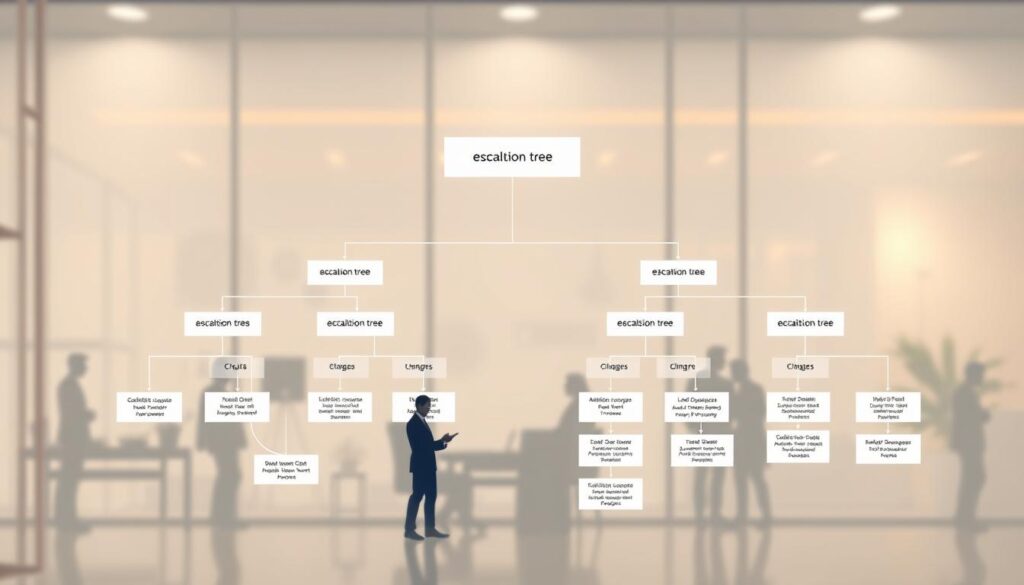
Building one requires honesty. You need to know who needs to know and when. The goal is a tree that can pass an auditor’s scrutiny but is simple to follow in a panic. It’s a balance between speed and protocol.
Let’s make it concrete. A sample escalation framework might look like this:
| Escalation Level | Trigger Event | Responsible Party | SLA Time | Next Step |
|---|---|---|---|---|
| Level 1 | Minor pricing discrepancy | Senior Trader | 15 minutes | Resolve or escalate to Desk Head |
| Level 2 | Major system outage | Desk Head / IT Lead | 5 minutes | Activate backup & notify CRO |
| Level 3 | Potential regulatory breach | Compliance Officer | 10 minutes | Formal review & legal consult |
| Level 4 | Enterprise-level risk event | Chief Risk Officer (CRO) | Immediate | Executive committee & external reporting |
The SLA column is key. It turns a vague responsibility into a measurable promise. This is the heartbeat of your operational discipline.
Integrating this with tools like risk heatmaps creates a powerful feedback loop. The heatmap finds the problems; the escalation tree tells you who to call and how fast. This is the monitoring performance that regulators and courts look for.
So, skip the panic party. Define the chain of command before the alarm sounds. Crafting a clear escalation tree isn’t red tape—it’s your best defense.
Continuous Improvement Loop
Think your trading desk’s Standard Operating Procedure is finished once it’s printed and filed? That’s like declaring a language dead. A static SOP gathers dust. It becomes the document you show an auditor while your team operates on pure instinct.
The real power isn’t in writing the perfect SOP on day one. It’s in the feedback loop. After every major event—a brilliant trade, a painful loss, a narrow escape—you must run a structured review. Call it a blameless post-mortem. In project management, they call it a “Post Occupancy Evaluation.” The goal is to harvest lessons, not assign fault.
You must institutionalize this loop. Schedule regular SOP review sessions, quarterly at a minimum. Keep a living log of all amendments in a shared, central document. Did the handover notes fail? Revise them. Did the escalation tree get clogged? Redraw it. Your procedures must evolve as fast as your markets do.
Cultivate an environment where suggesting a tweak to the SOP is seen as a sign of engagement, not criticism. This is intellectual curiosity in action. The ultimate aim is a desk that learns, adapts, and gets smarter with every single trading day. That’s the sage advice—build a living system, not a fossilized rulebook.