Decision-making is more than just logic. It’s a mix of thinking and feeling that shapes how we handle uncertainty. Studies show that memory and the setting of decisions impact our risk-taking. For example, how we see information can change our choices.
Our emotions also play a big part in what we prefer. Our current feelings and what we think we’ll feel later can influence our decisions. This is seen when fear or excitement changes what we choose. For instance, feeling scared might make us pick safer options, while feeling happy might make us take bigger risks.
It’s important to understand why we don’t always make rational choices. By looking at both our thoughts and feelings, we can see how flexible our attitudes towards risk are. To learn more, check out this research article.
Identifying Cognitive Biases in Decision Making
Decision making often gets swayed by cognitive biases. Psychologists talk about two main systems: System 1 and System 2. System 1 is quick, using intuition and emotions. System 2 is slower, more logical. Yet, even System 2 can fall prey to mental shortcuts, or cognitive biases, that skew our judgment.
Some common biases include:
- Confirmation Bias: People tend to seek out information that backs up what they already believe, ignoring opposing views.
- Hindsight Bias: After something happens, people often think they knew it would happen, creating an illusion of foresight.
- Availability Heuristic: This bias makes people judge risks based on the first examples that come to mind, not always accurately.
- Anchoring: People often rely too much on the first piece of information they get, which can influence their later decisions.
These biases can greatly affect our choices, even if we’re well-informed. For example, in high-pressure situations, our quick System 1 can take over, leading to irrational decisions. This is more likely in uncertain situations.
Knowing about these biases is the first step to better risk assessment. By recognizing these biases, we can spot when our decision making is off track. To dive deeper, check out this article on cognitive biases here or learn more about understanding cognitive bias here.

In summary, it’s key to recognize cognitive biases in our decision making. By being aware of these biases, we can aim for more informed choices. This improves our decision-making process overall.
Strategies for Mitigating Psychological Risks
To make better decisions, it’s key to use strategies that lower psychological risks. Knowing how our feelings affect our choices can help us do better. One good way is through emotion regulation (ER) strategies, which help manage our emotions when we decide.
Cognitive reappraisal is a big part of ER. It’s about changing how we see a situation to lessen its emotional impact. For instance, seeing a tough decision as a chance to grow can make us less anxious and clearer in our thinking. But, expressive suppression can stop us from showing our feelings, which might be okay in some cases but should be used carefully.
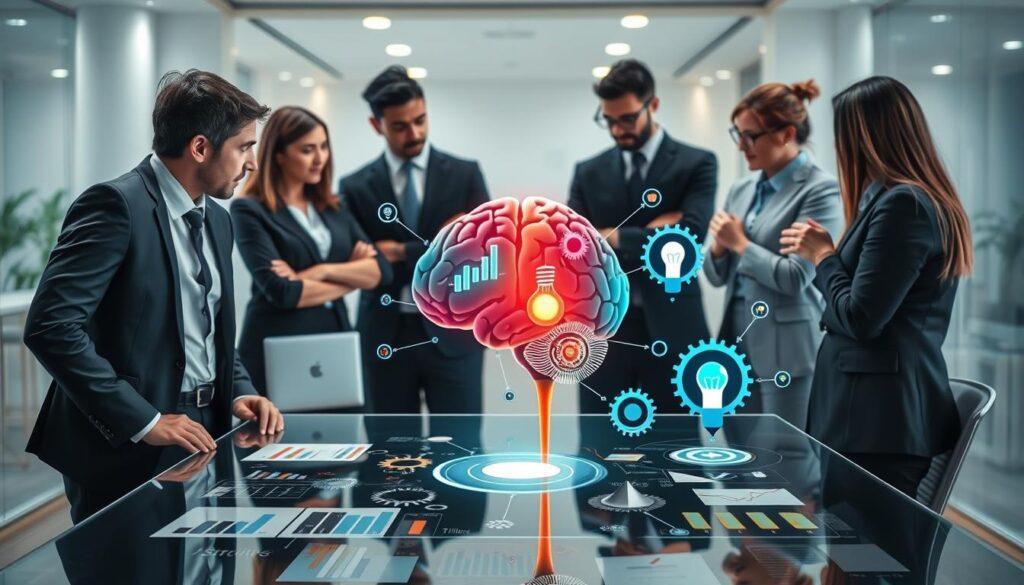
Also, having positive traits can really help with making decisions. Here are some traits to consider:
- Curiosity: It makes us explore and learn in safe situations, helping us make smart choices.
- Optimism: It helps us keep going even when things are unsure, making us stronger in medium-risk situations.
- Courage: It gives us the guts to face big challenges with confidence.
These traits can grow with practice and mindfulness, which uses System 2 thinking—our more thinking part. Using decision matrices can also fight biases, helping us see options more clearly.
Lastly, having a growth mindset is very important. It makes us more resilient and adaptable, letting us learn from past choices and get better at making decisions. By controlling our inner world, we can avoid acting on impulse or fear, making our decisions better.
For more tips on handling stress and making decisions, see this resource.
Practical Examples and Case Studies
Understanding risk behavior is key in fields like insurance and healthcare. For example, people often overstate the risks of events they remember well when buying insurance. This shows how fear of loss affects our choices.
A survey on flood insurance is a good example. People were more swayed by their fear of anxiety than by the actual loss they might face. This shows how emotions can take over rational thinking.
Imagine two people on a roller coaster. One is brave, seeing it as a challenge. The other is curious, wanting to try something new. Both do the same thing but for different reasons. This shows how our personal views of risk influence our actions.
In healthcare, knowing about biases like anchoring helps doctors get second opinions. This cuts down on mistakes and improves care. These examples show how understanding psychology can lead to better choices in many areas.